Grease Trap Requirements for UAE Catering Companies
Catering companies in the UAE operate under conditions that make grease trap management uniquely difficult. A standalone restaurant produces a relatively consistent volume of FOG day after day. A catering company might cook for 200 people on Monday, 50 on Wednesday, and 2,000 on Friday. The central production kitchen runs at full capacity during wedding season, idles during summer, and spikes unpredictably for corporate events. Then there are the satellite operations: temporary event kitchens, labour camp mess halls feeding 500-1,000 workers daily, and airline catering facilities running 24-hour production cycles.
Each of these environments has different grease trap requirements, different municipality jurisdictions, and different compliance challenges. This guide covers what UAE catering operators need to know.
Central Production Kitchen Requirements
The central kitchen is where a catering company does the bulk of its cooking. In Dubai’s industrial areas like Al Quoz, DIP, and JAFZA, catering company kitchens range from 200 sqm operations serving a few corporate clients to 2,000 sqm industrial facilities producing thousands of meals daily.
Trap Sizing for Variable Output
The fundamental challenge is that a central catering kitchen’s FOG output varies dramatically. During the October-March event season, production might run at 100% capacity six days a week. During summer, the same kitchen might operate at 30% capacity. The grease trap must be sized for peak, not average.
For a central kitchen producing 1,000-3,000 meals/day at peak:
- Primary grease trap: 5,000-10,000 litres, depending on menu composition and peak output
- Cleaning frequency (peak season): Weekly, sometimes twice weekly during December-January
- Cleaning frequency (off-season): Fortnightly to monthly, adjusted based on actual production volume
For smaller operations producing 200-500 meals/day:
- Primary grease trap: 2,000-3,000 litres
- Cleaning frequency: Weekly during peak, fortnightly during normal operations
Our installation specialists work with catering companies to size traps based on actual production data, not theoretical calculations. We review your menu mix, peak production records, and drainage layout to recommend the right capacity.
Event Kitchen and Temporary Setup Compliance
Large catering companies set up temporary kitchens at event venues: hotel ballrooms, exhibition centres, outdoor wedding venues, and private estates. These temporary operations still generate FOG, but they rarely have dedicated grease trap infrastructure.
Dubai Municipality and event venue operators increasingly require catering companies to demonstrate grease management provisions for temporary kitchens. This typically means:
- Portable grease interceptors on all wash sinks
- Used cooking oil collection in sealed containers for proper disposal
- No direct discharge of kitchen wastewater into venue drainage without pre-treatment
For outdoor events, where there is no drainage connection at all, catering companies must provide complete wastewater containment and arrange for removal by an approved waste contractor. The cost of this containment is a line item that should be built into event pricing, not absorbed as an afterthought.
Labour Camp Mess Hall Traps
Many UAE catering companies operate mess hall facilities in labour accommodation camps, serving 500-3,000 workers per meal. These facilities run two or three meal services daily, every day of the year, producing massive and consistent FOG volumes.
Labour camp mess halls present specific challenges:
Volume consistency: Unlike event catering, mess hall production is constant. The grease trap fills at a predictable rate, which makes scheduling easier but demands strict adherence to the cleaning calendar. A missed cleaning is guaranteed to cause a problem.
Remote locations: Many labour camps are in industrial zones or on project sites outside the main urban areas. The grease trap service provider must be willing and able to service these locations on schedule, including during Ramadan when meal timing shifts significantly.
Municipality jurisdiction: A catering company based in Dubai might operate mess halls in Abu Dhabi, Sharjah, Ajman, and RAK. Each emirate has its own municipality with its own enforcement department. Compliance documentation must satisfy each jurisdiction independently.
For mess hall operations, an AMC with guaranteed response times is essential. The cost of a blocked drain in a labour camp kitchen feeding 2,000 workers is not just a fine—it is a health and safety incident that can trigger MOHRE scrutiny.
Industrial-Scale Traps: 5,000-10,000 Litres and Above
Large catering operations require industrial-scale grease traps that are fundamentally different from the 500-2,000 litre traps used in restaurants. At 5,000 litres and above, the trap becomes a significant piece of infrastructure that requires:
- Structural support: A 10,000-litre trap full of water and grease weighs over 10 tonnes. The floor slab must be engineered to support it.
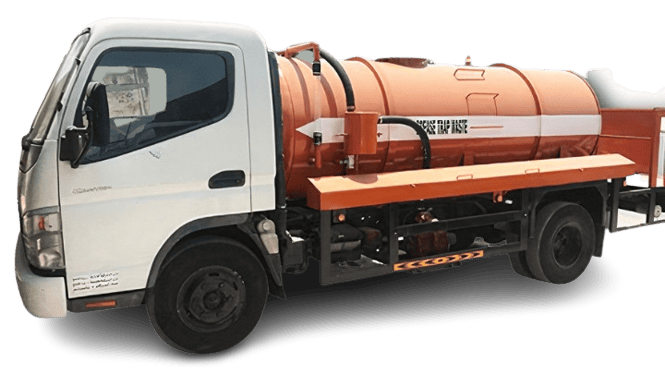
- Vehicle access: Pump-out requires a vacuum tanker to access the trap. The trap location must allow tanker access with adequate hose reach.
- Ventilation: Large traps in enclosed spaces generate hydrogen sulphide gas as grease decomposes. Proper ventilation is a safety requirement, not an option.
- Multi-compartment design: Industrial traps typically have three compartments to improve separation efficiency. Each compartment must be individually accessible for cleaning.
Installation of industrial traps should be planned during the facility fit-out stage. Retrofitting a 10,000-litre trap into an existing kitchen requires significant civil works, drainage modifications, and potentially structural reinforcement. Read more about installation and ongoing cost considerations.
Multi-Emirate Compliance
A catering company headquartered in Dubai with operations in Abu Dhabi, Sharjah, and the northern emirates must navigate multiple regulatory frameworks:
Dubai: Dubai Municipality Food Safety Department. Grease trap compliance is part of the food establishment license. DM-approved service providers must be used. Cleaning records must be maintained.
Abu Dhabi: ADAFSA. Stricter documentation requirements including waste manifests showing the origin, volume, and destination of all removed grease. Digital record-keeping is increasingly expected.
Sharjah: Sharjah Municipality. Similar core requirements to Dubai. Additional notification requirements for large trap installations.
Ajman, UAQ, RAK, Fujairah: Each has its own municipal authority. Enforcement intensity varies, but the core requirement—functioning grease traps maintained at proper frequency—is universal.
A single AMC provider covering all locations simplifies compliance enormously. Rather than managing four or five different contractor relationships across different emirates, the catering company has one provider, one contract, one set of records, and one point of accountability.
GTC operates across all seven emirates and provides multi-location AMC programs specifically designed for catering companies with distributed operations.
Seasonal Scaling of Cleaning Schedules
The UAE catering industry has a pronounced seasonal pattern. October through March is peak season: weddings, national day celebrations, corporate events, and holiday gatherings drive production volumes to their maximum. April through September is quieter, with summer seeing the lowest production volumes.
A well-structured AMC accounts for this seasonality. Cleaning frequency should scale with production volume, not remain fixed year-round. During peak season, weekly cleaning of the central kitchen trap might be necessary. During summer, fortnightly or even monthly might suffice. The AMC should include provisions for ad-hoc additional cleanings triggered by large-volume events, with pre-agreed pricing so there are no surprises.
Cost-Effective Grease Management for Catering Operations
Grease trap cleaning for catering companies starts from AED 99 per service, with AMC plans offering significant savings for high-frequency schedules. For a central kitchen with a 5,000-litre trap on a weekly cleaning schedule during peak season and fortnightly during off-season, the annual AMC cost is a fraction of the revenue loss from a single drainage incident that shuts down production during a 2,000-cover wedding.
GTC has served UAE catering companies since 2009. We understand the operational rhythm of catering—the peak-season pressure, the multi-site complexity, and the zero-tolerance for drainage failures when production deadlines are non-negotiable.
Call +971 58 570 7110 to discuss your catering operation’s grease trap requirements, or visit our contact page to arrange a site assessment of your central kitchen and satellite operations.