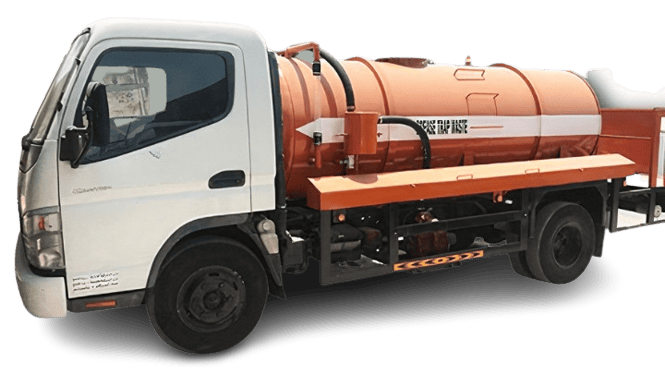

If your UAE property is not connected to the mains sewer network, its wastewater is handled by one of three things: a septic tank, a sewage holding tank, or a soakaway — and often a combination. They are easy to confuse, but the difference matters, because each needs a different kind of maintenance and a different collection schedule. Here is a plain-English guide.
Septic tank
A septic tank is a buried, watertight chamber that gives wastewater basic on-site treatment. Solids settle to the bottom as sludge, grease and light solids float to the top as scum, and the partially clarified liquid in the middle flows out to a soakaway. Bacteria break down some of the waste over time.
Maintenance: a septic tank does not need to be fully emptied as often as a holding tank, but the sludge layer builds up and must be pumped out periodically — typically every 6 to 12 months for a home — or it will carry over into the soakaway and clog it.
Sewage holding tank
A holding tank is simpler: a sealed tank that stores all wastewater with no treatment and no outlet. Nothing leaves it except by tanker. It is common on construction sites, temporary accommodation, and properties where a soakaway is not permitted or practical.
Maintenance: because it stores everything, a holding tank fills relatively quickly and must be pumped out on a regular schedule by a sewage tanker — how often depends entirely on its size and how many people use it.
Soakaway
A soakaway (also called a leach field or seepage pit) is not a tank at all — it is the underground pit or network of perforated pipes that receives the liquid discharged from a septic tank and lets it percolate slowly into the surrounding ground.
Maintenance: a soakaway has no contents to empty, but it can clog or flood — usually because the septic tank feeding it was not de-sludged often enough, or because the ground has become saturated. A clogged soakaway shows up as wastewater surfacing in the garden or drains backing up, and it needs clearing.
Quick comparison
- Septic tank — treats and separates; discharges liquid to a soakaway; needs periodic de-sludging.
- Holding tank — stores everything, no treatment, no outlet; needs regular tanker emptying.
- Soakaway — disperses treated liquid into the ground; needs clearing if it clogs or floods.
How do I tell which one I have?
If your property has a tank that only ever gets emptied by tanker and never seems to “drain away”, it is most likely a holding tank. If you have a tank plus a separate area of ground where water disperses, you have a septic-tank-and-soakaway system. If you are unsure, our crew can identify your setup during a free site survey and tell you what maintenance it needs.
Whatever you have, GTC can service it
We empty and de-sludge septic tanks, collect from holding tanks, and clear blocked soakaways and sump pits — across all seven emirates, with disposal at government-approved treatment plants. Every load is handled by a licensed operator; see the rules in our UAE sewage tanker regulations guide, or find your local service in Dubai sewage tanker service, septic collection in Abu Dhabi, Sharjah tanker collection and beyond.
Frequently asked questions
Can a septic tank replace a holding tank?
Only where a soakaway is permitted and the ground allows percolation. In many UAE areas a sealed holding tank is required instead, with regular tanker collection.
Why does my soakaway keep flooding?
The most common cause is a septic tank that has not been de-sludged often enough, so solids have passed into the soakaway and clogged it. Regular tank de-sludging protects the soakaway.